Emergency Tree Service Augusta GA — 24/7
Storm damage? Tree on your house? We dispatch 24/7 across Augusta & CSRA. Call (762) 320-1106 any hour.
24/7 Emergency Response · Free Estimates · Richmond County & CSRA
24/7
Emergency Response
Free
Estimates Always
100%
Insured & Licensed
CSRA
Wide Coverage
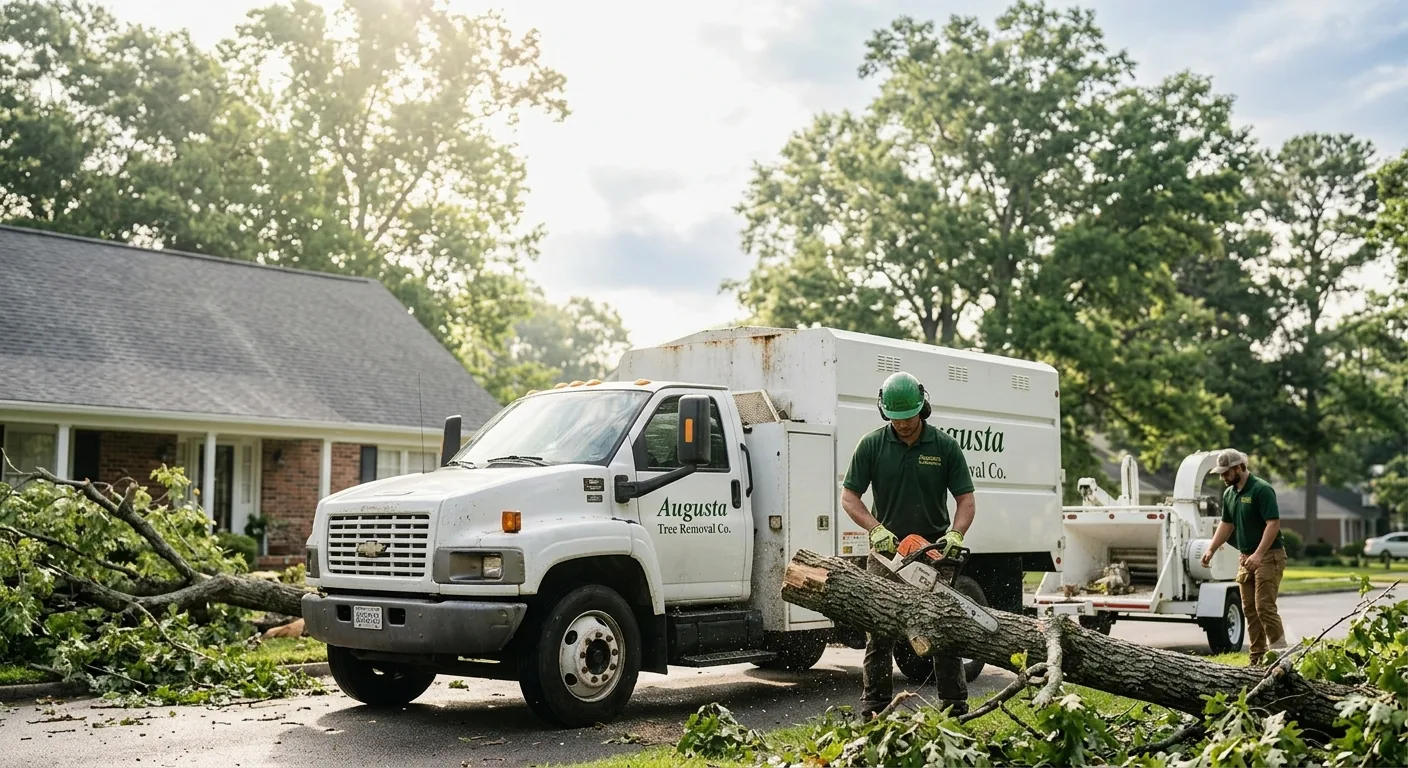
When a tree comes down during a storm, blocks your driveway, or threatens your home, you need a crew that answers — not a voicemail. We provide 24/7 emergency tree service throughout Augusta, Richmond County, and the CSRA. Augusta's hurricane season runs June through October, and severe storm events can happen any month.
Augusta's hurricane season runs June through October, though severe storms can happen any month, requiring a crew that answers, not a voicemail. We stabilize active hazards immediately — trees on structures, blocked roads, leaning trees, hanging limbs — then complete removal safely. Augusta Tree Removal Co. provides 24/7 emergency tree service throughout Augusta, Richmond County, and the CSRA.
Call (762) 320-1106 any hour for emergency dispatch. We stabilize active hazards immediately and complete full removal once the site is safe.
Emergency tree work in Augusta starts at the standard $300 to $2,500 removal range and carries an after-hours premium, with storm jobs involving a tree on a structure landing at the top of that band or beyond. For baseline comparison, ProMatcher puts a scheduled Augusta removal at about $395 and general tree work at $130. Homeowners posting real emergency invoices report $775 for a straightforward after-hours removal and $8,750 where a large tree came down on a house, with $6,000 to $9,000 quoted as the comparison range. The reason not to wait is structural rather than financial: a partially fallen or split tree holds load in ways that are invisible from the ground, and the second failure is what turns a yard cleanup into an insurance claim. Photograph everything before any cutting starts if a structure is involved — the adjuster will ask.
Cost figures cited from ProMatcher and invoices posted on r/homeowners. Published market data for reference, not a quote for a specific property.
When it is holding load it was not built to hold. After a CSRA storm that means three cases specifically. A tree or large limb resting on a roof, vehicle, fence or power line is an emergency by definition. A partially uprooted tree is one too — the sign is soil heaved into a ridge on the side opposite the lean, which means the root plate has lifted and what is left holding it is not what was holding it last week. The third and most underestimated is a limb hung up in the canopy rather than fallen: it can release hours or days later with no further weather and no warning. Everything else is usually a scheduled job at standard rates — broken small branches, stripped foliage, and a tree still standing straight with undisturbed soil at the base.
Warning signs you should not wait on: anything touching a structure or a line, soil cracked or lifted on one side of the trunk, a fresh split where two trunks meet, and limbs suspended overhead. Keep people and vehicles clear underneath and call immediately for a tree leaning noticeably more than it did last month, fresh cracks or heaved soil on the ground at its base, or a split where two trunks meet. Those mean the tree is actively failing and the yard under it should be kept clear until it is looked at.
Handle it in sequence rather than by price. If any limb is on a power line or a service drop, the utility comes before any crew, and a company that offers to cut it clear anyway has answered your question about how it works. Next, get three things before dispatch: a stated arrival window, the full after-hours figure rather than an hourly rate, and insurance you can verify tonight — which matters most in the week after an ice storm, when crews from out of the area and from across the South Carolina line arrive and not all carry coverage valid here. Ask whether they photograph the scene before cutting, since that is the record an adjuster reads. Then split the job: stabilization and tarping tonight, full removal priced calmly in daylight.
Active hazard? Don't wait. Call (762) 320-1106 now — we dispatch 24/7.
(762) 320-1106Free estimates · 24/7 emergency · All CSRA